WORDS

WORDS

João de Almeida

João de Almeida

pHOTOS

pHOTOS

CorkTalk

CorkTalk

dATE

dATE

30th April 2026

30th April 2026

From Brief to Direction: Defining Creative Strategy in the Age of AI

AI doesn’t necessarily make designers more creative, it amplifies whatever vision and art direction skills you actually have.

That was the issue with CorkTalk, a wine community stuck between styles and audiences:

  • It spoke like an expert.

  • But explained it to a beginner.

  • Avoided traditional visuals.

  • But was undefined as an alternative.

The brief was “make wine more accessible”. That, of course, lead to a generic output.

"The issue wasn’t about design at all. It was a problem with strategy."

So I reframed it:

Not more accessibility. But relevance.

Using different LLMs (Gemini, Claude, ChatGPT), I stress-tested the positioning, challenged the tone, audience assumptions, and strategic gaps. The issue became clear: lack of focus from the brand.

Wine communication tends to be either elitist or oversimplified. CorkTalk was both, wrongfully.

So I repositioned it as intentionally niche:

  • The anti-snob wine guide for the Amsterdam weekend.

  • For a smaller and younger audience.

  • No traditional wine visuals or explanatory jargon.

  • Lifestyle pairing instead of Food pairing.
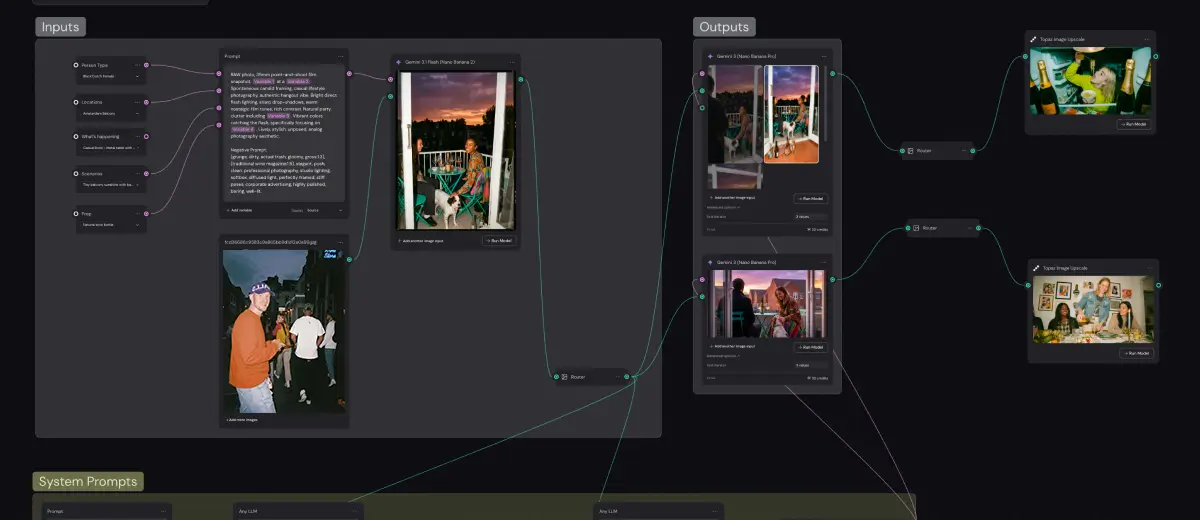
This made for a stronger identity. From there, I explored two directions and pressure-tested them using AI, not for outputs, but for range:

  • How far a visual system could stretch.

  • Where ideas collapsed into cliché.

To avoid generic results, I used a node-based workflow (Weavy.AI) that embeds art direction directly into the system. Outputs became inputs - but curation and refinement stayed manual (Figma art boards, After Effects motion).

The old direction failed quickly. The new one didn’t.

I committed to it and defined constraints:

  • What type of content is generated through a scalable AI workflow.

  • Generated content must fit into the buckets defined by strategy.

  • Staying small and uncomplicated is mandatory.

Then I validated it:

  • Published small batches.

  • Used Instagram boosts to test engagement.

  • Identified what created interaction vs passive consumption.


At the end, AI didn’t define the direction. It helped me get there faster and kill weaker ideas earlier. As a result, the Instagram page doubled user engagement in less than 10 days when compared to the previous strategy in a similar time frame. Still small, but more impactful in its adoption.

If I was leading a team of junior designers, I'd stress the value of AI isn’t in generating a lot of sloppy options. It’s in choosing a solid one and making it work over time and across channels.

Share article

Share article

More to read